
Trump Accounts
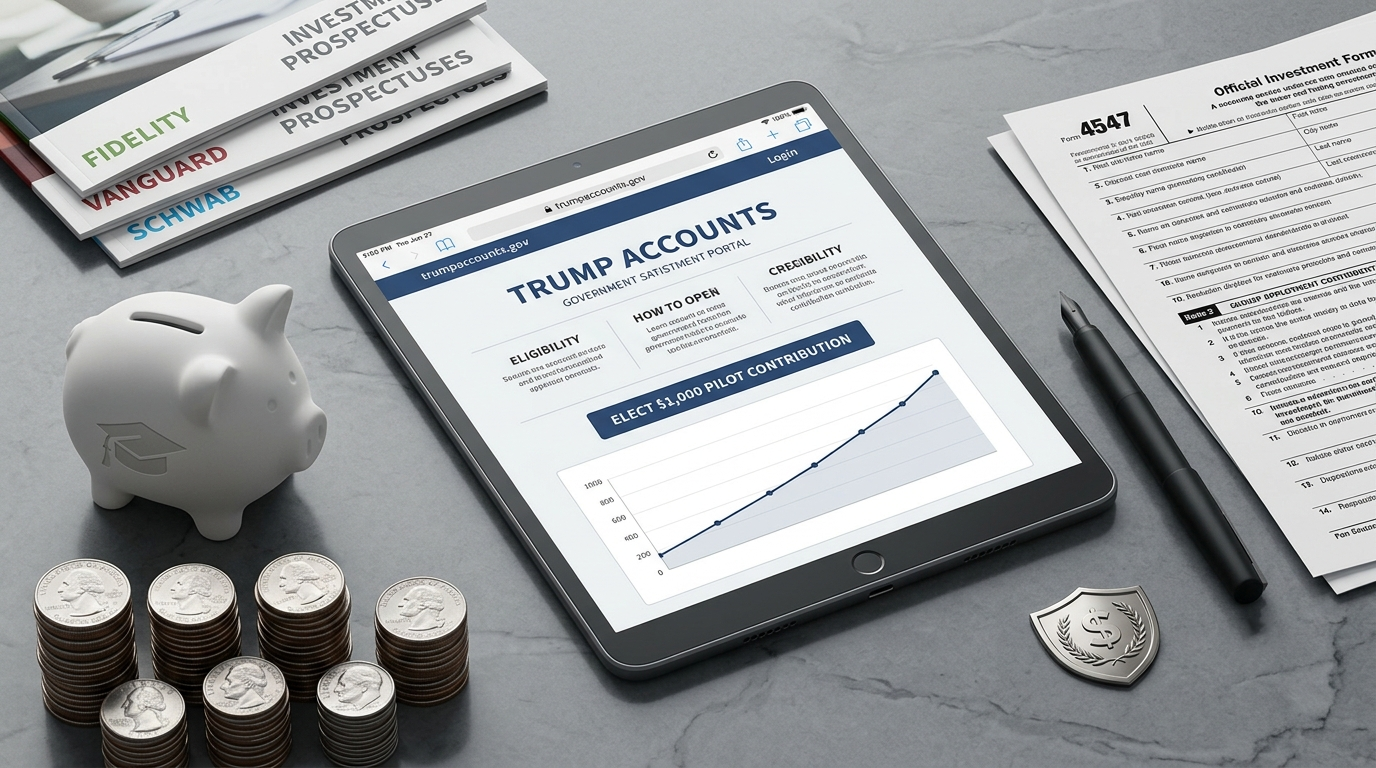
Trump Accounts
By Caitlin Allard, Director of ARC
July 1, 2026
What they are
A Trump Account is a traditional IRA established under new IRC §530A, held in a minor’s name, with a parent or guardian serving as custodian until the child turns 18.
Eligibility
Any U.S. child under age 18 with a Social Security number is eligible. A one-time $1,000 federal “pilot program” contribution applies to U.S. citizens born from January 1, 2025, through December 31, 2028.
How to open one
Opening a Trump Account starts with an election through the IRS, either by filing Form 4547 or using the online tool at trumpaccounts.gov. Parents, guardians, and other authorized individuals can use an IRS Individual Online Account to complete Form 4547 and, if eligible, elect the $1,000 pilot contribution. The Treasury sets up and administers the initial account, with rollovers to financial institutions available after launch. The IRS is expected to issue additional guidance in the coming weeks on rollover accounts, which may be opened only after the initial Treasury account exists.
Note: Opening the account (the “authorized individual”) must follow a strict priority order: legal guardian, then parent, then adult sibling, then grandparent. A lower-priority person may file Form 4547 only if no higher-priority person is available. For example, a grandparent may open the account only if the child has no legal guardian, parent, or adult sibling able to do so; a parent being uninterested or generally unavailable is not enough.
After the account is open, the rules are more flexible. Grandparents and other family members may contribute to an established account, subject to the shared $5,000 annual aggregate limit across all contributors, even though they generally cannot establish the account. The first person to successfully file Form 4547 becomes the account’s “responsible party,” and only one account may exist per child, so duplicate filings by another family member will be rejected.
Custodians
The Treasury Department has designated the Bank of New York Mellon (BNY) as the program’s financial agent, with Robinhood serving as brokerage and initial trustee for the Treasury-administered account. For rollovers, Fidelity, Vanguard, and Charles Schwab are preparing to serve as account trustees, though the IRS has not yet published a final list of approved private trustees.
Investments
Investments are limited to low-cost index mutual funds or ETFs that track the S&P 500 or a similarly broad domestic index and have an expense ratio capped at 0.10%.
Contribution limits
- Other individuals may contribute up to a shared aggregate limit of $5,000 per year per child.
- Employers may contribute up to $2,500 per year toward an employee’s or dependent’s account. This amount counts against the $5,000 cap but is not included in the employee’s taxable income.
- Contributions are not deductible. Unlike IRAs, there is no “prior-year” contribution window through the tax filing deadline; funds must be contributed during the calendar year.
- The $5,000 limit is indexed for inflation after 2027.
- Contributions count toward the annual gift tax exclusion ($19,000 in 2026).
Distributions
Amounts generally cannot be withdrawn before January 1 of the year the child turns 18. After that, the account is generally treated as a traditional IRA and is subject to the usual traditional IRA rules.
Sources:
Instructions for Form 4547 (12/2025) | Internal Revenue Service
BOOK A FREE CONSULT
Brianne Soscia
Certified Financial Planner™
The opinions voiced in this material are for general information only and are not intended to provide specific advice or recommendations for any individual. We suggest that you discuss your specific situation with your financial advisor prior to investing. All performance referenced is historical and is no guarantee of future results.
Investing in stock includes numerous specific risks including: the fluctuation of dividend, loss of principal and potential illiquidity of the investment in a falling market.
Dollar cost averaging involves continuous investment in securities regardless of fluctuation in price levels of such securities. An investor should consider their ability to continue purchasing through fluctuating price levels. Such a plan does not assure a profit and does not protect against loss in declining markets.
All investing involves risk including loss of principal. No strategy assures success or protects against loss.