
Helping Clients Avoid Tax Penalties
Helping Clients Avoid Tax Penalties
By Caitlin Allard, Director of ARC
June 21, 2026
One of the most common—and easily preventable—tax surprises clients face is the IRS underpayment penalty. As you work through mid-year reviews, it’s a good moment to check whether clients are on track.
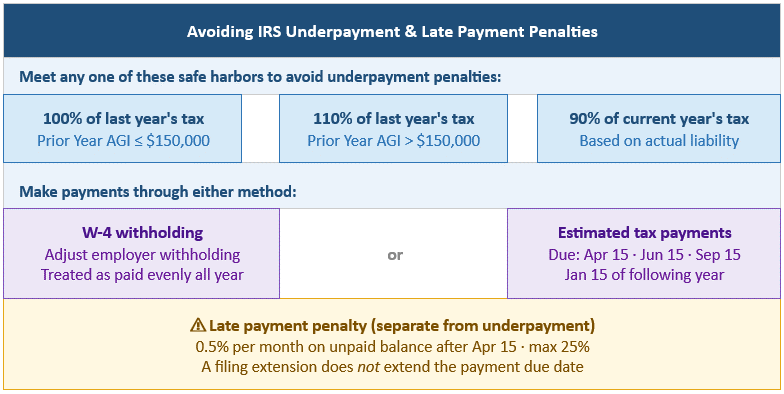
The safe harbor rules. Clients can avoid the underpayment penalty entirely by meeting one of three IRS safe harbors: paying at least 90% of the current year’s tax liability, 100% of the prior year’s tax (for clients with AGI at or below $150,000), or 110% of the prior year’s tax (for higher-income clients). The 110% threshold is one clients frequently miss—worth flagging for anyone who had a meaningful income spike last year.
Two ways to fund the obligation. Payments can be made through W-4 withholding at work or through quarterly estimated tax payments (due April 15, June 15, September 15, and January 15). One key advantage of withholding: it’s treated by the IRS as paid evenly throughout the year, which can help clients who come into income late in the year avoid a timing penalty on earlier quarters.
How much is the underpayment penalty? If a client falls short of a safe harbor, the IRS calculates the penalty based on the federal short-term rate plus 3 percentage points—adjusted quarterly. For 2025 and into 2026, that rate has been in the 6–7% range (annualized). The penalty is applied to the underpaid amount for each quarter it remained underpaid, meaning it compounds across the year if multiple quarters are short. While the penalty rate may seem modest, clients with large underpayments across multiple quarters can accumulate a meaningful charge—and it’s entirely avoidable with proper planning.
Don’t conflate underpayment with late payment. A separate penalty applies when the balance due isn’t paid by April 15—0.5% per month on the unpaid amount, up to 25%. Clients sometimes assume a filing extension also extends their payment deadline. It does not. Encourage anyone who can’t pay in full to file on time anyway, pay as much as they can, and explore IRS installment options for the remainder.
States set their own rules. Most states have underpayment penalty regimes that broadly mirror the federal structure, but the thresholds, rates, and due dates vary—sometimes significantly. Do not assume federal safe harbor compliance automatically satisfies state requirements.
BOOK A FREE CONSULT

Brianne Soscia
Certified Financial Planner™
The opinions voiced in this material are for general information only and are not intended to provide specific advice or recommendations for any individual. We suggest that you discuss your specific situation with your financial advisor prior to investing. All performance referenced is historical and is no guarantee of future results.
Investing in stock includes numerous specific risks including: the fluctuation of dividend, loss of principal and potential illiquidity of the investment in a falling market.
Dollar cost averaging involves continuous investment in securities regardless of fluctuation in price levels of such securities. An investor should consider their ability to continue purchasing through fluctuating price levels. Such a plan does not assure a profit and does not protect against loss in declining markets.
All investing involves risk including loss of principal. No strategy assures success or protects against loss.